
Milam County Court Record Requests
Use re:SearchTX for a statewide public index, register, filings, documents, and hearings where covered. District civil, criminal, family, and juvenile files route to District Clerk Karen Berry. County misdemeanor, civil, probate, and guardianship files route to County Clerk Jodi Morgan. JP and municipal files remain with the court that heard the matter.
- Identify the exact court, cause or citation number, case style, and document title or date range.
- Search online, call the clerk, or inspect records at the proper counter. Mail or email a precise written request when the office permits it.
- State whether the request is for inspection, an ordinary copy, a certified copy, or the public register of actions.
- Ask about current search, page, certification, delivery, and redaction charges before paying.
- Compare the delivered record with the request and retain the clerk’s certification when one was ordered.
The practical channels are the clerk pages, phone and fax or email shown there, in-person counters, linked forms, local iDocket lead, re:SearchTX, statewide Topics search, and individual city systems. The Texas courts open-records policy explains law but is not a Milam submission portal.
Two Milam Court Record Custodians
The split clerk structure prevents one office from producing every file. The District Clerk maintains the 20th District Court record and works from Suite 5 on the third floor at 102 S Fannin Ave., Cameron. The County Clerk keeps County Court case records and many separate non-court county records.
The official District Clerk capture shows the local starting page.
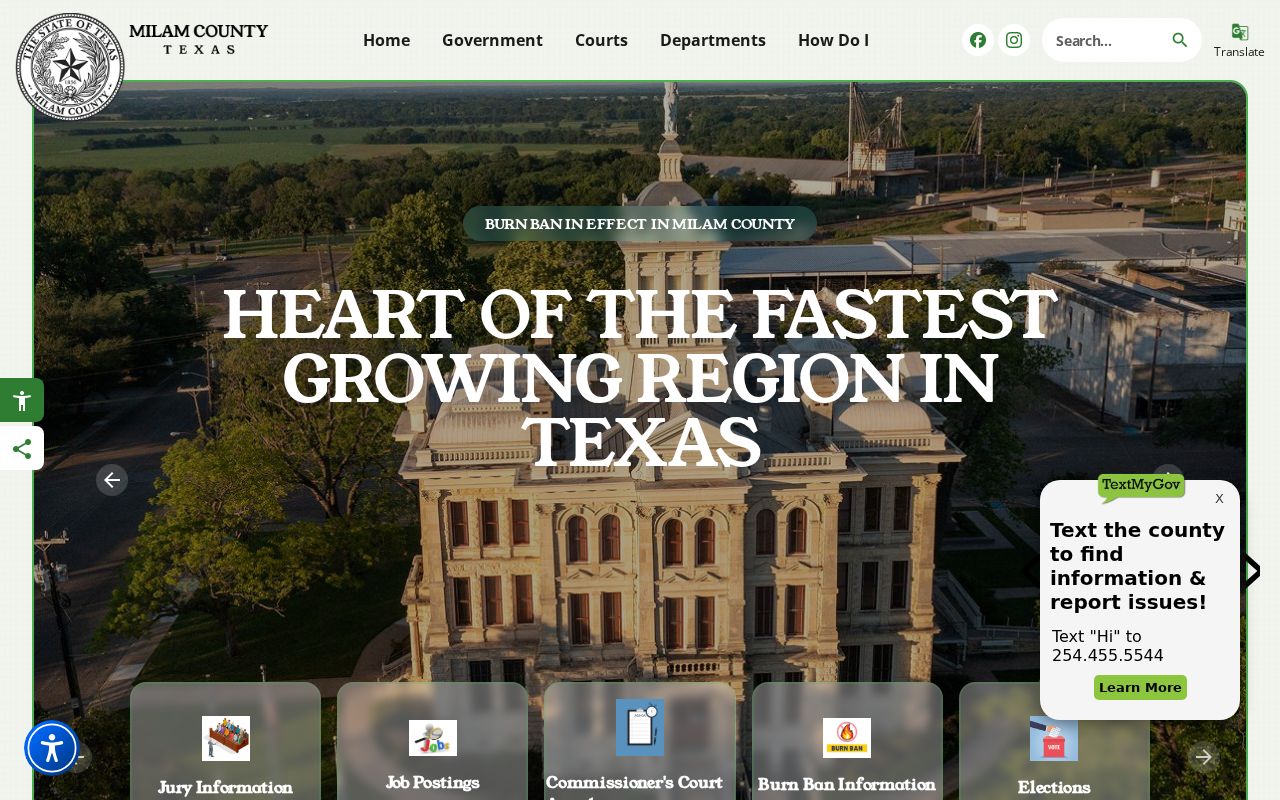
The page links forms, docket information, standing orders, and payment material, but a link is not proof that every completed filing is public.
Kinds of Court Records
A court file can contain procedural entries and actual filed documents. Probate and family matters add specialized material, while JP and municipal files often center on citations, pleas, and dispositions. Ask for named items rather than “everything” when the need is specific.
- Pleadings, petitions, answers, counterclaims, motions, affidavits, and notices
- Citations, service returns, warrants or process, bonds, and registry material
- Orders, judgments, jury papers, transcripts, and appellate notices
- Probate wills, applications, inventories, accounts, and letters
- Municipal or JP citations, pleas, deferred or driving-safety requests, and payment histories
Milam Docket Versus Case File
A docket or register of actions is the chronological index. The case file holds the documents named by that index. A re:SearchTX document icon does not guarantee a public image. Account rules, payment, court technology, scanning status, sealing, juvenile limits, or sensitive-data treatment may block an image even while the event line remains visible.
| Docket or register | Full case file |
|---|---|
| Event dates and labels | Pleadings, exhibits, orders, and other documents |
| Useful for locating an item | Useful for reading the filed item |
| May appear online | May require a clerk request, fee, or redaction |
Request a document by its exact title and filing date. “No image” does not prove that no filing exists.
Court Records: What They Contain
A file should be read with its docket. Exact contents vary by case type and public access status. A filed assertion is not a finding, a notice is not proof of service, and a system status is not always a plain-language outcome.
| Cause Number | The court identifier and strongest request key. |
|---|---|
| Pleadings | Petitions, answers, motions, and other filed positions. |
| Orders & Judgments | Signed directions and recorded decisions of the court. |
| Docket Sheet | The chronological event index or register of actions. |
| Exhibits | Filed evidence or attachments when publicly available. |
Milam Forms Reveal Record Types
District forms include civil issuance requests, setting requests, nondisclosure orders, child-support withholding papers, CPS compensation forms, and financial affidavits. County Clerk links include a public-information request, criminal-history search request, indigence forms, and other county material. These lists help name a document, but they do not establish that a completed form is open.
The civil issuance request is the one local form with a researched handling detail: prepared issuance not collected within 14 business days is destroyed, and delivery may be by email. That rule concerns issuance, not a general copy turnaround promise. No current standard turnaround for Milam court copies was located.
Note: Ask the clerk for the current delivery estimate rather than applying a timing statement from an unrelated form.
Copy Fees and Certification
An ordinary copy reproduces the available document. A certified copy adds the custodian’s authentication or seal. An online download is not certified merely because it came from an official portal. State and local charges are separate, and dated schedules must be confirmed.
| Item | Amount |
|---|---|
| District Clerk search | $5 |
| District Clerk copy | $1 per page |
| District certified copy or seal | $5 |
| County Clerk copy / certification / listed name search | $1 per page / $5 / $5 |
| re:SearchTX public document | $0.10 per page, up to $6 |
Milam County District Clerk
102 S Fannin Ave., Suite 5
Cameron, TX 76520
(254) 697-7052
Precise Milam Copy Requests
Use wording such as “ordinary electronic copy of [document title] filed [date] in cause [number]” or “certified copy with clerk certification and seal.” Add contact information, court, case style, date range, desired delivery method, and a request for the current total. Separate a one-case request from a broad data request.
The County Clerk fee schedule is dated January 1, 2021. The District Clerk schedule is labeled 2024. Neither should be treated as a current quote without verification. Ask whether search time, pages, certification, postage, or electronic delivery changes the estimate.
If the office asserts a redaction or exception, ask for the authority and whether a redacted version can be released. A clerk may explain the record process but cannot interpret the legal effect of a filing.
Milam Court Record Redactions
Before a public copy is shared, check for Social Security numbers, driver-license numbers, birth dates, bank or account numbers, protected addresses, child-identifying information, medical data, and confidential reports. The fact that a portal displayed a file does not remove a legal restriction or make every identifier fit for republication.
Possible access labels include sealed, restricted, confidential, sensitive data, document unavailable, redacted, or juvenile. They are not interchangeable. Record the exact label, date, court, and authority if shown. A missing image can also reflect scanning or system limits, so ask the clerk rather than guessing.
For district family, juvenile, or criminal records, contact the District Clerk. County probate, guardianship, and misdemeanor files route to the County Clerk. City and JP files go to the issuing court. Ask whether an ordinary redacted copy, inspection, or certified public copy is available.
Access Rules for Court Records
Texas generally permits inspection of public judicial records, but access can be limited by a sealing order, court rule, statute, or sensitive-data requirement. Juvenile, family, protective, victim, child, medical, and financial material need special care. A public event may remain visible while its document is withheld or redacted.
Key Rules:
Texas Rule of Judicial Administration 12 states a general inspection rule and exceptions for judicial records.
Texas Rules of Civil Procedure 76a and 21c address civil sealing procedure and sensitive data.
Texas Family Code Chapter 58 governs special juvenile-record confidentiality and access limits.
The Texas courts Open Records Policy distinguishes judicial records from administrative records under the Texas Public Information Act. Ask the custodial clerk for the procedure that applies to the specific case file. Keep a dated copy of the request and response.